
Engineered to improve cable quality, manufacturing consistency, and production capacity for advanced high-temperature superconductor cable manufacturing
A leading manufacturer in the advanced energy sector required a more reliable and scalable method for producing high-temperature superconductor (HTS) cables. The existing process relied on a manually operated prototype that bundled Kapton-coated HTS wires using twisting and spiral wrapping methods.
While the prototype successfully demonstrated the manufacturing concept, it created significant challenges for production-scale operation. Manual setup and operation introduced variability in wire tension, spiral wrapping consistency, and overall cable quality. The process was also limited in the length of cable assemblies that could be produced, restricting manufacturing throughput and scalability.
Another critical challenge involved particulate contamination generated during the bundling process. Debris created during cable handling frequently contaminated the sensitive insulated wires, leading to quality concerns and testing issues. At the same time, growing customer demand required increased production capacity and a more repeatable manufacturing process.
The client partnered with Re:Build DAPR to develop an automated cable bundling system capable of producing HTS cables up to 200 meters in length while maintaining precise tension control, consistent wire wrapping, and improved manufacturing cleanliness.
Re:Build DAPR began by analyzing the client’s existing prototype process and identifying the critical variables that influenced cable quality and production performance. The team focused on industrializing the manual process while preserving the successful aspects of the original design.
A major engineering focus involved maintaining precise and repeatable tension across multiple HTS wire spools throughout the bundling process. Because tension variations could negatively impact cable performance and wrapping consistency, the team developed specialized wire handling and braking solutions capable of controlling multiple wire paths simultaneously.
The engineering team also evaluated methods for reducing particulate contamination, improving cable handling consistency, and increasing production throughput. Motion studies, tension calculations, and structural analysis were performed to validate system performance and ensure long-term reliability under production operating conditions.
Throughout development, Re:Build DAPR worked to create a solution that improved automation and process control while maintaining operational flexibility for setup and manufacturing adjustments.
Re:Build DAPR designed and built a fully integrated automation platform that transformed the client’s manual cable manufacturing process into a scalable production system.
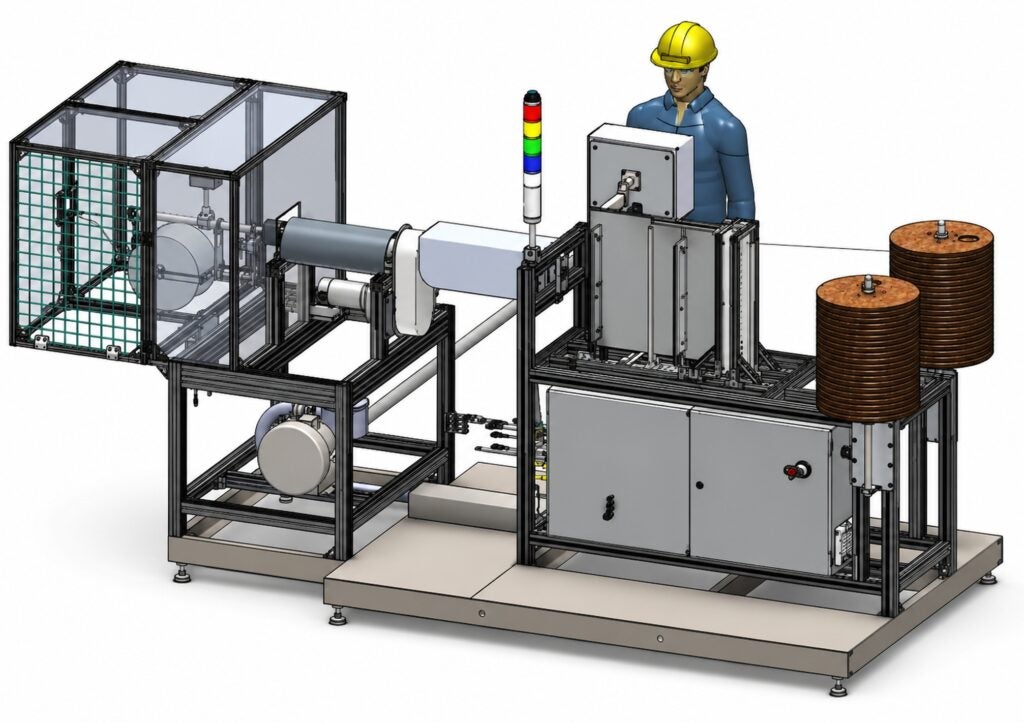
At the core of the solution was a custom cable bundling and pulling machine capable of managing up to 20 HTS wire spools simultaneously. A proprietary O-ring braking system was developed to maintain consistent tension across all wire spools while eliminating particulate generation commonly associated with traditional braking methods.
The system incorporated a precision winch pulling mechanism that accurately controlled cable tension and pull speed throughout production. Adjustable pattern boards guided wire positioning and spacing, while an automated twisting and spiral wrapping system ensured consistent cable construction and reduced operator variability.
To improve product quality, Re:Build DAPR integrated cleaning, inspection, and vacuum particle collection systems throughout the process. These systems continuously removed debris and protected the sensitive polyimide insulation used on the HTS wires.
The resulting platform automated the most labor-intensive portions of cable production while preserving manual setup capability when required, providing both manufacturing efficiency and operational flexibility.
Re:Build DAPR successfully delivered an automated HTS cable bundling system that significantly improved production capability, product consistency, and manufacturing reliability.
The new platform enabled the production of HTS cable assemblies up to 200 meters in length while maintaining precise tension control and consistent spiral wrapping throughout the process. Automated operation reduced labor requirements, minimized operator variability, and improved overall cable quality.
By eliminating particulate contamination and improving process consistency, the system provided the client with a more robust manufacturing platform capable of supporting growing production demands and future technology development.
The success of the project led directly to the delivery of a second machine and strengthened Re:Build DAPR’s relationship with the client as a trusted automation and manufacturing partner.
The HTS cable bundling system included:
Let’s talk about your unique challenges and how Re:Build DAPR can help you.
